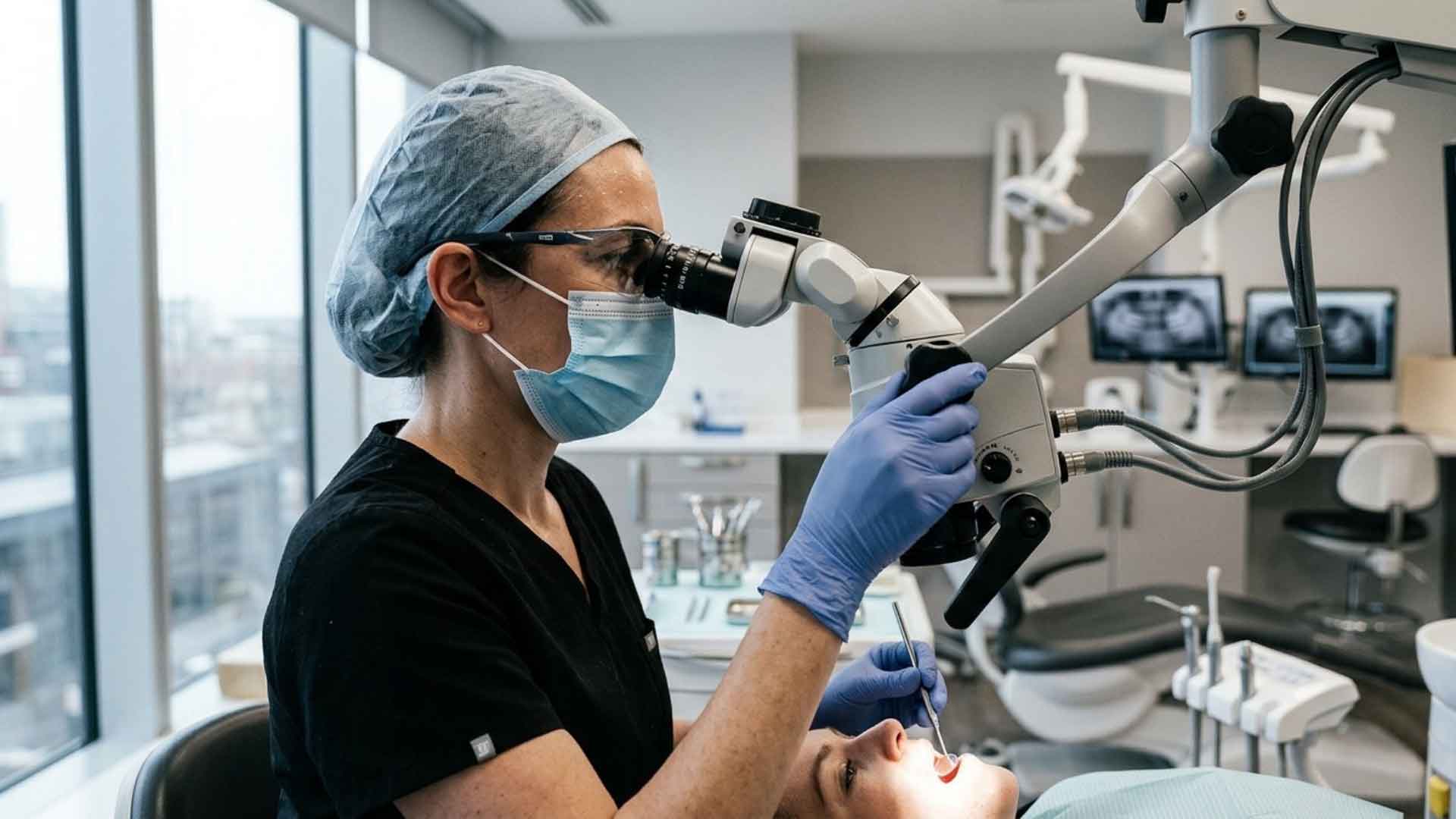
Persistent discomfort after a root canal may indicate a condition that non-surgical treatment alone cannot fully resolve. Endodontic microsurgery provides direct access to the root and surrounding tissue, allowing a specialist to address problems that standard root canal techniques cannot reach.
At Renovo Endodontic Studio, our endodontists evaluate complex cases using advanced 3D imaging and microsurgical techniques to determine if surgery is the appropriate next step.
What Is Endodontic Surgery?
Endodontic surgery addresses problems near the root of a tooth when traditional root canal treatment cannot fully resolve the issue. This treatment allows your endodontist to access the root area directly, remove affected tissue, and seal the root to support healing. Most patients who need it have already had one root canal, and the surgery addresses infection or damage at the root level that non-surgical treatment could not fully resolve.
Endodontic microsurgery refers to the modern form of this treatment, performed under a dental operating microscope with instruments designed for work at a scale the unaided eye cannot resolve. The magnification changes what a specialist can see and treat, which is why the terms appear together throughout this page.
When Is Endodontic Microsurgery Needed?
Endodontic microsurgery may be recommended when a previous root canal does not fully resolve a problem or when certain conditions make traditional treatment difficult. This procedure allows your endodontist to directly address issues around the root that cannot be reached through conventional root canal techniques.
Common reasons an endodontist may recommend microsurgery include:
Persistent infection after root canal treatment: Infection or inflammation may remain in areas of the root canal system that are difficult to access through traditional treatment. Our guide on what to do when a root canal fails explains the options available at that point.
Calcified canals that limit access: Calcified canals (canals narrowed by mineral deposits) can prevent instruments from reaching the full length of the root.
Complex anatomy or hidden concerns: Additional canals, isthmuses (narrow connections between canals within the same root), small fractures, or other root-related concerns may require evaluation with advanced imaging.
Root fractures or dental trauma: Imaging may reveal damage that requires a surgical approach rather than nonsurgical treatment. Our cracked tooth repair service covers fracture cases in detail.
Continued pain or swelling after completed treatment: Ongoing symptoms may indicate that further evaluation is needed to determine the source of the problem.
Patients experiencing urgent dental symptoms should receive an evaluation to determine if emergency endodontic care or another treatment option is appropriate.
If a previously treated tooth continues to hurt when biting or shows changes on an X-ray, our team can evaluate the cause and determine if endodontic microsurgery or another treatment option is appropriate.
What Types of Endodontic Surgery Are Available?
Endodontic surgery includes several procedures designed to address complex problems around the root of a tooth. At Renovo Endodontic Studio, specialists use advanced techniques to evaluate each case and determine the most appropriate treatment approach. These procedures address concerns that cannot always be resolved through conventional root canal therapy alone.
Apicoectomy and Root-End Resection
An apicoectomy, also called root-end resection, removes the tip of the tooth root along with surrounding infected or inflamed tissue. This procedure may help treat a problem that remains near the root after previous root canal treatment or an area that cannot be reached through traditional methods.
During the procedure, your endodontist uses magnification to carefully access the root area, removes affected tissue, prepares the root end, and seals the area with a small filling designed to protect against bacterial entry.
Calcified canals develop when calcium deposits narrow the root canal space, making it difficult for standard instruments to reach the full length of the canal. In these cases, endodontic surgery may allow your endodontist to access the affected area directly and complete treatment from the outside of the root. Our article on calcified cases explains when these teeth remain treatable.
Dental operating microscopes improve visibility and precision during complex procedures. This level of magnification helps specialists identify small structures and carefully treat areas that are difficult to access through traditional methods. Our overview of the dental operating microscopes explains how the technology changes what is possible at the root level.
Exploratory Surgery for Hidden Problems
Some causes of persistent symptoms may not appear on standard dental imaging. Small fractures, additional canals, or other concerns around the root may remain difficult to identify after previous treatment.
Exploratory surgery allows specialists to examine the root surface directly under magnification and determine the cause of the problem. The findings help guide the next treatment decision.
Intentional Replantation
Intentional replantation involves removing the tooth from its socket, treating the root outside the mouth under magnification, then returning the tooth to its original position. The extraction is deliberate and controlled, performed with the intent of preserving the tooth rather than replacing it.
This approach applies to a narrow set of cases. It may be considered when the root tip cannot be reached safely through the gum and bone because of nearby anatomy, or when previous surgical treatment at the root tip has not resolved the problem. Our case discussion on intentional replantation illustrates how specialists evaluate candidacy for this procedure.
What Happens During Microsurgical Treatment?
Every procedure at Renovo Endodontic Studio begins with a detailed evaluation using 3D CBCT (cone beam computed tomography) scans. This technology helps specialists identify concerns such as infection around the root tip, root anatomy, fractures, or bone changes that may not appear on traditional X-rays.
During the procedure, specialists use microsurgery techniques to carefully access and treat the affected area. The treatment process typically includes:
Accessing the root area: Your endodontist creates a small opening near the root tip to reach the affected tissue.
Removing affected tissue: Your endodontist removes infected or inflamed tissue around the root.
Preparing the root end: Ultrasonic instruments (precision tools that use high-frequency vibration to shape the root tip) preserve healthy tooth structure during this step.
Sealing the root: A biocompatible filling material seals the root end to help prevent bacteria from entering again.
Closing the surgical site: Your endodontist cleans and sutures (closes with stitches) the area to support healing.
Treatment length varies depending on the tooth’s location and complexity. Your endodontist will provide a more specific timeline during your consultation.
After treatment, patients usually have sutures removed within 5 to 7 days. Our team provides aftercare instructions to support healing, including guidance on swelling management, diet, and recovery.
Bone healing around the root may continue for several months after the surgical site feels normal. Follow-up visits and imaging allow specialists to monitor the tooth’s progress.
Research, including a meta-analysis by Setzer et al. (2010), reports a weighted success rate of approximately 94% for microsurgical endodontic procedures, with reported ranges across studies falling between roughly 85% and 95%. Results depend on factors such as infection severity, root anatomy, the presence of fractures, and how the tooth responds to treatment.
Why Choose Renovo for Endodontic Microsurgery?
Renovo Endodontic Studio combines specialist training and advanced technology to evaluate and treat complex root-related conditions. Patients and referring dentists choose the practice because of:
Advanced imaging for precise evaluation: 3D CBCT scans provide detailed views of the tooth, root structure, and surrounding bone to help identify concerns that may not appear on traditional X-rays.
High-magnification treatment: Dental operating microscopes improve visibility during surgery, allowing specialists to carefully examine and treat small structures around the root.
Specialized endodontic training: Our endodontists complete advanced endodontic residency training and focus on diagnosing and treating complex root-related conditions.
Individualized treatment planning: Each recommendation considers the tooth’s condition, previous treatment history, imaging findings, and clinical evaluation rather than applying the same approach to every case.
Natural tooth preservation focus: Our endodontists evaluate treatment options with the goal of preserving the natural tooth when appropriate.
Endodontic microsurgery is available at all four locations: Schaumburg, Elgin, Downers Grove, and Rockford. Each office is equipped for microsurgical treatment, so patients can receive care at the location most convenient to them.
Sedation Options for Patient Comfort
Surgical treatment raises comfort questions that a routine appointment does not, and our specialists discuss sedation during the consultation rather than on the day of surgery. Three options are available:
Nitrous oxide: Inhaled sedation that eases anxiety during the procedure and wears off quickly afterward, allowing most patients to drive themselves home.
Oral conscious sedation: Medication taken before the appointment that produces a deeper state of relaxation. Patients who choose this option need someone to drive them home.
General anesthesia: Administered by a visiting dental anesthesiologist for patients whose medical history or level of dental anxiety calls for it. Availability requires advance scheduling.
Local anesthesia numbs the surgical area in every case, with or without sedation. Our sedation therapy page explains each option in more detail.
Schedule an Endodontic Microsurgery Consultation Today
A tooth that continues to cause discomfort after a root canal may need further evaluation. Renovo Endodontic Studio provides detailed assessments to identify the cause of the problem and discuss available treatment options.
Contact us to schedule a consultation and learn if endodontic microsurgery may be appropriate for your tooth.
FAQs About
Endodontic Microsurgery
What is endodontic surgery?
Endodontic surgery treats problems around the root of a tooth that cannot be fully resolved with a standard root canal alone. The procedure allows your endodontist to access the root area directly, remove affected tissue, and seal the root to support healing.
The most common type of endodontic surgery is an apicoectomy, also called root-end resection. Specialists may also use surgery to identify concerns such as small fractures or hidden canals that may not appear on standard X-rays.
What is an apicoectomy?
An apicoectomy removes the tip of a tooth’s root along with nearby infected or inflamed tissue. After removing the affected area, the end of the root is cleaned and sealed to help prevent bacteria from entering again.
This procedure may be recommended when a previous root canal has not fully healed or when a problem remains near the root tip. Our guide to understanding apicoectomy in dental care explains the procedure in plain terms.
Why would I need endodontic surgery after a root canal?
Most root canals heal successfully, but some teeth continue to show signs of infection or inflammation after treatment.
This can happen when bacteria remain in complex areas of the root canal system that are difficult to reach with traditional treatment. Endodontic surgery provides direct access to the root area to address the remaining issue.
Is endodontic surgery painful?
The procedure itself should not cause pain because the area is numbed with local anesthesia before treatment begins. Most patients feel pressure or movement rather than discomfort during surgery.
Mild soreness or swelling may occur after treatment and usually improves within a few days. Our practice also offers sedation therapy options for patients who want additional comfort during their procedure.
How long does recovery take after endodontic microsurgery?
Many patients return to normal activities shortly after endodontic microsurgery. Swelling often peaks around the second day and gradually improves.
Sutures are typically removed within 5 to 7 days. Although the surgical area may feel better quickly, complete bone healing around the root can take several months.
What happens during recovery?
After surgery, your endodontist will provide instructions for caring for the treated area during healing. Recovery recommendations may include following temporary dietary restrictions, managing swelling with ice packs as directed, keeping the surgical area clean, and taking recommended medications as instructed.
Following post-treatment instructions helps support proper healing and a smoother recovery process.
What is the success rate of endodontic microsurgery?
Reported success rates for endodontic microsurgery range from approximately 85% to 95%, and a meta-analysis by Setzer et al. (2010) reported a weighted success rate of 94%. Outcomes vary based on factors such as the condition of the tooth, root anatomy, and the presence of fractures. Our endodontists evaluate these factors during consultation to determine the most appropriate treatment option.
What are the alternatives to endodontic surgery?
The main alternative to endodontic surgery is tooth extraction. After extraction, patients may need a dental implant, bridge, or other replacement option to restore function.
Whenever possible, preserving the natural tooth is the preferred goal because it helps maintain your existing bite and oral function.
How does endodontic microsurgery differ from non-surgical retreatment?
Nonsurgical retreatment treats the tooth from inside the existing root canal by removing and cleaning the previous filling material. Endodontic microsurgery accesses the root tip from outside the tooth through a small opening in the gum and bone.
Microsurgery may be considered when factors such as calcified canals, complex anatomy, or hidden concerns make retreatment less predictable.
Can I drive home after surgery?
In most cases, yes. Patients who receive local anesthesia can usually drive themselves home after endodontic surgery. If sedation is used, you will need someone to drive you home after the appointment.
Does insurance cover endodontic surgery?
Insurance coverage for endodontic surgery varies by plan. Many dental insurance plans provide some coverage for surgical endodontic procedures.
Renovo Endodontic Studio accepts most major insurance plans and can help patients understand their benefits and payment options. Visit the insurance and financial information page for more details.